2026-09-17
Ball Joint Failure: Symptoms, Safety Risks, and Replacement


New Products Catalog

Remove RFQ Item
Back

A ball joint is the pivot that connects a vehicle's control arm to the steering knuckle, allowing the wheel to turn and the suspension to move up and down simultaneously. When it wears, the symptoms progress from subtle noise to genuine safety risk: a severely worn ball joint can separate while driving, causing sudden loss of steering control. For repair shops and aftermarket distributors, recognizing the early symptoms, understanding the failure mechanism, and specifying quality replacement parts is essential for both customer safety and repeat business. This guide covers the five key failure symptoms, how to diagnose them, the safety risks of delayed replacement, and what buyers should verify when sourcing replacement ball joints.
| Symptom | Likely Cause | Diagnosis Method | Risk Level | Action |
|---|---|---|---|---|
| Clunking / knocking over bumps | Ball joint play, worn socket | Listen on rough roads; check play on lift | Medium | Inspect; replace if play is felt |
| Steering wander / vague feel | Excessive radial or axial play | Rock wheel by hand on lift; check free play | Medium-High | Replace immediately; align after |
| Uneven / feathered tire wear | Toe drift from loose joint | Inspect tire edges; check alignment history | Medium | Replace joint; perform 4-wheel alignment |
| Steering wheel shimmy at speed | Ball joint + tie rod wear combined | Check entire front end; isolate by rocking | High | Full front-end inspection; replace worn parts |
| Sudden steering pull / wheel lock | Ball joint separation (catastrophic) | Visual inspection; joint may be visibly separated | Critical | Do not drive; tow to shop; replace immediately |
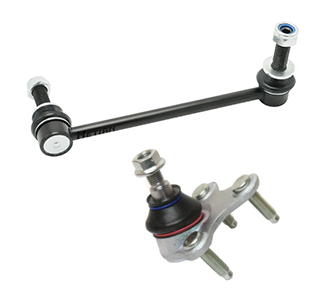
A ball joint consists of a hardened steel ball stud seated in a precision-machined socket, sealed by a rubber dust boot and packed with grease. The ball stud's tapered shank is pressed into the steering knuckle, while the housing bolts to the control arm. This design allows the wheel to pivot for steering and articulate for suspension travel, but every movement creates microscopic wear between the ball and the socket [1]. Over time, the grease degrades, the socket wears, and play develops.
The single most common cause of accelerated ball joint failure is a torn or cracked dust boot. Once the boot is damaged, water, grit, and road salt enter the joint, acting like sandpaper on the ball and socket surfaces and washing out the lubricating grease [1]. A boot with a visible crack should be treated as a warning sign even if no play is yet detectable—grit has already entered and wear is accelerating. Vehicles driven frequently on rough roads, over potholes without slowing, or up curbs may wear ball joints at 50,000–60,000 km, while normal highway use can extend service life significantly [5].
The most reliable diagnostic method is a physical play check on a vehicle lift. With the front wheels off the ground, the technician grasps the wheel at the 12 o'clock and 6 o'clock positions and rocks it in and out, feeling for any perceptible radial or axial movement at the ball joint. Any perceptible play is considered failure—the joint should be firm with no detectable movement [3]. A second check at the 3 o'clock and 9 o'clock positions helps distinguish ball joint wear from tie rod end wear, though both can produce similar symptoms and are often inspected together [2].
On the road, the first symptom is typically a clunking or knocking noise from the front suspension when driving over rough surfaces or speed bumps—the sound of the worn ball moving within its socket [7]. As wear progresses, steering becomes vague or wanders at highway speeds because the loose joint allows the wheel to change toe angle unpredictably [1]. Uneven or feathered tire wear on the front edges is a secondary indicator: the drifting toe causes the tire to scrub rather than roll [9]. A steering wheel shimmy or vibration at certain speeds often indicates combined ball joint and tie rod wear, and warrants a full front-end inspection rather than replacing a single part [5].
A worn ball joint is not merely a comfort issue—it is a safety-critical failure. In the worst case, a severely worn ball joint can separate while the vehicle is in motion: the ball stud pulls out of the socket, the wheel suddenly changes angle or locks, and the driver loses steering control [1]. This is why technicians describe ball joint wear as having a "断轴风险" (axle-break risk) when ignored—the consequences of separation are catastrophic, especially at highway speed [6].
Even before separation, a worn ball joint compromises braking stability and directional control. The vehicle may pull to one side under braking, and the loose joint can cause the wheel to shimmy, reducing tire contact with the road [8]. Because ball joint wear is progressive and the symptoms are often subtle at first, many drivers continue operating the vehicle until the joint is near failure. Repair shops should treat any detectable play as an immediate replacement recommendation, not a "monitor and return later" item [7].
Ball joint replacement requires pressing the old joint out of the control arm (or replacing the complete control arm assembly on vehicles where the joint is not serviceable) and pressing in the new joint, followed by a mandatory four-wheel alignment, since any change to the ball joint position alters toe and camber settings [3]. When sourcing replacement ball joints, buyers should verify five quality points: (1) the ball stud is case-hardened steel with a precision-ground surface; (2) the housing is forged or cast steel with proper heat treatment, not a soft casting; (3) the dust boot is oil- and ozone-resistant rubber (chloroprene or equivalent) with a secure crimp; (4) the joint is pre-greased for life with a high-quality lithium-based grease; and (5) the supplier provides dimensional inspection data confirming the taper angle, thread pitch, and stud length match the OE geometry [1].
Buyers should prioritize suppliers holding IATF 16949 certification, which ensures the same quality management system, traceability, and process capability controls apply to aftermarket parts as to OEM components. Hetian Auto has manufactured suspension and chassis components since 1998, operates a 160,000 m² production facility, holds IATF 16949 and CNAS laboratory accreditation, exports to more than 30 countries, and holds over 100 patents—the manufacturing depth that supports consistent ball joint quality across high-volume aftermarket production.
Q: What are the first signs of a bad ball joint?
A: The earliest symptom is usually a clunking or knocking noise from the front suspension over rough roads or speed bumps. As wear progresses, steering becomes vague or wanders at highway speeds, and the front tires may develop uneven or feathered wear. Any of these symptoms warrants a physical play check on a lift [1][7].
Q: How do I check a ball joint for wear?
A: With the vehicle on a lift and the front wheels off the ground, grasp the wheel at 12 o'clock and 6 o'clock and rock it in and out. Any perceptible radial or axial movement at the ball joint indicates wear—the joint should be firm with no detectable play. Also inspect the rubber dust boot for cracks or tears; a damaged boot means grit has already entered and wear is accelerating [1][3].
Q: Is it safe to drive with a worn ball joint?
A: No. A severely worn ball joint can separate while driving, causing sudden loss of steering control—a catastrophic failure especially dangerous at highway speed. Even before separation, a worn joint compromises braking stability and directional control. Any detectable play should be treated as an immediate replacement, not a deferred repair [1][6][8].
Q: How long do ball joints typically last?
A: Service life depends heavily on driving conditions. Normal highway use can extend ball joint life well beyond 100,000 km, but vehicles driven frequently on rough roads, over potholes without slowing, or up curbs may wear ball joints at 50,000–60,000 km. A torn dust boot is the single biggest accelerator of premature failure [1][5].
Q: Should I replace ball joints in pairs?
A: Yes, it is recommended to replace ball joints in pairs (left and right) to maintain consistent steering geometry and alignment. Even if only one side shows wear, the other side has experienced similar loading and is likely to fail soon. After replacement, a four-wheel alignment is mandatory, as ball joint replacement changes toe and camber settings [3].
Q: What should I verify when buying aftermarket ball joints?
A: Verify: (1) case-hardened steel ball stud with precision-ground surface; (2) forged or heat-treated steel housing; (3) oil- and ozone-resistant rubber dust boot with secure crimp; (4) pre-greased for life with high-quality grease; (5) dimensional inspection data confirming taper angle, thread pitch, and stud length match OE geometry. Prioritize IATF 16949-certified suppliers [1].
[1] "球头松旷自行检查指南," 搜狐汽车, August 10, 2026, https://m.sohu.com/a/1061027893_122759267/, accessed September 7, 2026.
[2] "汽车底盘异响,换摆臂胶套就能解决?未必," 网易新闻, August 25, 2026, https://c.m.163.com/news/a/L56MQ0KN0556ON8X.html, accessed September 7, 2026.
[3] "摆臂胶套更换周期与检测标准," 搜狐汽车, August 12, 2026, https://m.sohu.com/a/1061970469_122952324/, accessed September 7, 2026.
[4] "底盘异响是隐患,拉杆胶损坏的5个典型表现," 搜狐汽车, August 25, 2026, https://m.sohu.com/a/1067150398_122759267/, accessed September 7, 2026.
[5] "TT转向手感虚位严重,转向内外球头老化," 搜狐汽车, August 15, 2026, https://m.sohu.com/a/1063161994_122951895/, accessed September 7, 2026.
[6] "悬挂有异响赶紧查!球头磨损不换有断轴风险," 搜狐汽车, November 20, 2025, http://db.m.auto.sohu.com/model_5762/a/956402362_120012562, accessed September 7, 2026.
[7] "汽车球头坏了需要马上更换吗," 太平洋汽车百科, July 13, 2025, http://m.pcauto.com.cn/baike/847800/1661654/, accessed September 7, 2026.
[8] "汽车球头损坏了需要马上更换吗," 太平洋汽车百科, August 20, 2025, http://m.pcauto.com.cn/baike/1815546/2835557/, accessed September 7, 2026.
[9] "2026年中许昌拉杆球头更换服务指南:底盘异响跑偏这样解决省心," 南宁网络广播电视台, August 22, 2026, http://www.nntv.cn/shangxun/article-xdim-3005228.html, accessed September 7, 2026.